Mangawhai is in the middle of the longest sustained residential building boom this part of Northland has ever seen. Kaipara District Council's building consent data bears out what anyone who's driven Tara Road or the Heads in the last three years can see in front of their windscreen - new builds, extensions, reclads, and second-storey additions are going up at a pace the area's local trade base can't fully absorb. The shortfall is being made up by builders driving north from Auckland and west from Whangārei, some of them excellent, some of them learning Kaipara's rules on your job.
That makes choosing the right builder for a Mangawhai project a meaningfully different decision than it was in 2018. The downside risk is real: a poor build choice on a coastal section can mean weathertightness work in three years, structural rework in five, and a six-figure remediation bill against the value of a home that should have been weather-tight from day one. The upside is that the builders worth working with in this market are easy to identify if you know what to look for.
This is a Mangawhai-specific buyer's guide for 2026. It covers the licensing and guarantee questions every buyer should ask, the local regulatory context that out-of-region builders most often miss, what "coastal-spec" actually means when you read it on a quote, how to read a fixed-price contract for the things builders bury in it, and the 12 questions worth asking before you sign anything. It's written from the inside of a working Mangawhai-area building company, but it's not a sales piece - the questions in it apply to any builder you're considering, including us.
If you want the wider Northland-perspective version of this conversation, see our companion piece How to Choose a Builder in Northland. This one stays focused on Mangawhai.
1. Licensed Building Practitioner status - the non-negotiable
The Building Act 2004 and the Building (Designation of Building Work) Regulations make Licensed Building Practitioner status a legal requirement for the parts of a residential build that matter most. "Restricted building work" - any work that contributes to a home's weathertightness or structural performance - must be either carried out by, or supervised by, an LBP licensed in the relevant class. That covers foundations, framing, roofing, cladding, and the interfaces between them. The full official definition is on building.govt.nz.
The LBP scheme has seven licence classes - Carpentry, Site, Design, Bricklaying & Blocklaying, External Plastering, Foundations, and Roofing. A builder running a typical Mangawhai new build will hold Carpentry as a minimum and often Site (which authorises supervision across the build) on top. Specialist sub-trades are licensed in their own classes.
The single most useful thing a buyer can do is verify the licence themselves. The LBP register is a free public lookup at lbp.govt.nz/public-register. Search the builder's name, see which licences they hold, see whether the licence is current and unrestricted, and read any disciplinary history that's been recorded against them. The whole check takes 30 seconds. We list our own LBP numbers when clients ask, and we expect them to verify - it's the bare minimum.
If a builder is hesitant to give you their LBP number, that is the answer. Walk away.
A note on subcontracting: many Mangawhai builds use subcontracted carpenters, electricians, plumbers, and roofers. The LBP question applies to whichever person actually holds the supervisory responsibility for the restricted building work on your site - not the company name on the invoice. Ask who that person is, by name, and verify them.
2. The guarantee schemes - what they cover and what they don't
This is the area where buyers are most often confused, sometimes deliberately by builders who lean on the marketing of a scheme without ever offering its protection.
There are two major industry-backed guarantee schemes operating in New Zealand residential construction. Both work the same way: the builder is a member of an industry association, and on a per-build basis they can issue a 10-year insurance-backed guarantee that covers the buyer for things the standard Building Act and Consumer Guarantees Act cover only partially.
The Master Build 10-Year Guarantee, offered by member firms of the Registered Master Builders Association, covers loss of deposit if the builder goes under before construction starts, non-completion of the build if the builder fails during construction, and structural defects for ten years from completion. The scheme is underwritten by an insurer and the cover is independent of the builder's continued trading.
The Halo 10-Year Residential Guarantee, offered by member firms of New Zealand Certified Builders, works on broadly the same model - loss of deposit, non-completion, and structural defect cover - and is underwritten by a separate insurer.
The two critical points buyers miss:
- Membership of the association is not the guarantee. A builder can be a Registered Master Builder or a Certified Builder and not issue a guarantee on your build - either because they choose not to, or because the project doesn't qualify, or because the buyer doesn't pay the premium. The guarantee only exists if it is issued for your specific build, in writing, with a guarantee certificate.
- Without one of these schemes, you're relying on the standard statutory protections - the Consumer Guarantees Act, the Building Act 2004's implied warranties (including the 10-year limitation period for defective building work claims under section 393), and whatever insurance the builder personally carries (public liability and contract works being the standard pair). These are real protections - but they're contingent on the builder still trading and being able to remedy the defect, which is exactly the problem an insurance-backed guarantee is designed to solve.
Where we sit on this: Boaz Developments is a member of New Zealand Certified Builders. As above though, membership is not the guarantee - the Halo 10-Year cover only exists if it is issued for your specific build, with a guarantee certificate, and we are not currently issuing Halo as standard on every project. We carry public liability and contract works insurance, work to LBP-supervised standards on every job, and stand behind our work directly within the statutory timeframes. If a 10-year insurance-backed guarantee is essential for your project, raise it with us up-front so we can be honest about whether we're the right fit - we'd rather have that conversation early than have you sign on without the protection you actually want. That's the standard we'd hold any builder to.
3. Kaipara District Council fluency - the local regulatory layer
Mangawhai's regulatory geography catches a lot of out-of-region builders off-guard. Three different councils touch projects in this area:
- Kaipara District Council - Mangawhai township, Mangawhai Heads, most rural blocks west and north of the Heads.
- Auckland Council - Te Arai. The district boundary runs through farmland north of Te Arai, so every Te Arai section is Auckland Council, not Kaipara, despite being ten minutes down the road from Mangawhai.
- Whangārei District Council - Langs Beach, Waipu, Waipu Cove, Bream Bay, Ruakaka.
Each council has its own consent system, its own duty officers, its own inspection booking process, and its own quirks. The KDC-specific items that catch builders most often:
- Coastal hazard overlays. Sections close to the coast or at low elevation often sit within KDC's coastal erosion or coastal inundation overlays, which can trigger a resource consent on top of the standard building consent - and add anywhere from 4 to 12 weeks and several thousand dollars to the consent process.
- On-site wastewater. Most rural Mangawhai sections are not on a reticulated sewer - they require an on-site wastewater system designed and installed under TP58 and AS/NZS 1547:2012. KDC requires the design to be lodged as part of the consent and inspected on installation. A builder who has never specified one will sub-contract the work without understanding the design constraints, which can drive significant late-stage redesign.
- Tank water sizing. Rural Mangawhai homes are typically on collected rainwater. KDC requires minimum collection and storage capacities relative to roof catchment area and household occupancy.
- Rural zone bulk-and-location. KDC's rural zones have specific yard, height-to-boundary, and outbuilding rules that differ from Auckland Council's equivalents - and assuming Auckland rules apply on a Mangawhai rural block has cost more than one project a redesign and a fresh consent fee.
The single best question to ask a builder at the shortlist stage: "How many KDC consents have you personally taken from lodgement through to Code of Compliance Certificate, in the last 24 months?" The answer should be a number, not a story. If a builder is bidding on Mangawhai work and that number is zero, they will be learning KDC's process on your job, and you will be paying for the learning curve.
For a deeper walkthrough of the consent journey itself - lodgement, inspections, CCC sign-off - see our companion piece Building Consent to Code of Compliance in Northland.
4. Coastal-spec - what "marine-grade" actually means on a quote
"Coastal-spec" and "marine-grade" are two of the most over-used phrases in Northland building marketing. Used loosely they mean nothing. Used precisely, they refer to a specific set of material and detailing decisions that protect a build from the airborne salt environment that affects every site between Mangawhai Heads and Langs Beach.
The technical reference points worth understanding before you read a quote:
- NZS 3604:2011 Timber-framed buildings is the design standard underlying most New Zealand residential builds. It defines wind zones (Low, Medium, High, Very High, Extra High) and corrosion zones (Zone B inland through Zone E severe marine). Most of Mangawhai sits in High or Very High wind zone. Coastal Mangawhai - within roughly 500 metres of the open coast - sits in corrosion Zone D or E, the two most aggressive classifications.
- E2/AS1 - External moisture acceptable solution is the Building Code clause that governs cladding, flashings, and weathertightness detailing. It contains the formal weathertightness risk matrix and the cladding system requirements that flow from a site's exposure zone. The full text is on building.govt.nz.
- BRANZ publishes the practical guidance the trade actually uses to translate those standards into specifications. Their resources on coastal exposure, durability, and corrosion zones are at branz.co.nz.
What that means in practical terms when you're reading a Mangawhai builder's specification:
- Fixings. Stainless steel grade 316 ("marine grade") for any exposed fastener, bracket, or fitting. Grade 304 stainless is fine inland; in coastal Zone D-E it pits and stains within a few years. Hot-dip galvanised steel has its place in concealed structural applications but should not be doing exposed weathertightness work in this environment.
- Cladding. Cedar weatherboard with proper end-grain sealing, fibre-cement weatherboard on a cavity batten system, durable composite weatherboard, or a properly-detailed plaster system on a cavity. Direct-fix plaster on framing should not be specified for new coastal work full stop - the weathertightness history of late-1990s Mangawhai homes is the cautionary tale.
- Joinery. Thermally-broken aluminium or timber-framed joinery with double glazing rated for the relevant wind load. Standard non-thermally-broken aluminium will sweat in this environment; lighter-spec joinery will deflect and leak in High wind zone conditions.
- Roofing and flashings. Pre-painted steel roofing with the upgraded coastal coating system (the standard inland coating warranty is reduced or void in Zone D-E); flashings sized and specified to E2/AS1 for the relevant exposure.
- Insulation and ventilation. Current H1 insulation requirements, plus deliberate ventilation strategy - extract fans on humidistats in wet rooms, mechanical ventilation in tight modern envelopes - to manage the moisture loads the higher-performance envelope creates.
Our deeper post on this - including soil and foundation considerations specific to the Heads - is Building in Mangawhai's Coastal Environment. For pricing context on what coastal-spec actually adds to a build versus an inland equivalent, see Cost to Build in Mangawhai 2026.
5. Reading a fixed-price contract - and the allowances trick
Most reputable Mangawhai builders will offer a fixed-price contract for a new build with a complete documentation set. Fixed-price protects you from material cost movements within the defined scope - but it only does that to the extent the scope is actually defined. The two ways builders move risk back onto the buyer inside a fixed-price contract are PC sums and provisional sums.
A prime cost (PC) sum is an allowance for an item the buyer has not yet selected - typically appliances, sanitary ware, light fittings. The contract carries an allowance, the buyer makes selections during the build, and the contract is adjusted up or down based on actual cost.
A provisional sum is an allowance for work whose scope cannot be defined precisely up-front - typical examples are earthworks on a sloped site, retaining walls, or remediation work behind existing linings on a renovation.
Both are legitimate tools. The way they get misused is when a builder sets the allowance too low to make the headline contract figure look competitive, knowing the actual cost will come in well above. The buyer signs based on the headline number, the allowances are exceeded, and the variations land mid-build with limited room to push back.
What to look for when reading a contract:
- Every PC sum should reference a real product spec - "Kitchen tapware: Methven Maku Sink Mixer, allowance $850" is a defendable allowance. "Tapware allowance $400" without a product reference is a trap.
- Provisional sums should have a defined methodology - "Earthworks: provisional sum based on cut-and-fill of 80m³ at $90/m³ = $7,200, adjusted to actual" is fine. "Earthworks PS $5,000" with no quantity basis is not.
- Variation procedure should be in writing. Every variation - regardless of trigger - should be priced and signed before work proceeds. Verbal agreements during a site walk-through are how buyers end up with surprise bills.
- The contract should specify the standard form being used. The two industry-standard residential contracts are NZS 3902 and the Master Build / NZIA / ACENZ residential building contract. A builder using a hand-drafted contract on residential work is not a hard no, but it warrants a closer read.
For the per-square-metre figures, site cost ranges, and consent fees that should anchor your budget conversation, see Cost to Build in Mangawhai 2026.
6. Premium and architectural builds - what separates the field
The user-facing question of the Mangawhai market in 2026 is no longer "can I find a builder" - it's "can I find a builder capable of delivering an architecturally-designed coastal home to the standard the design calls for". The premium segment of the market is where most of the new build value is concentrated, and it's the segment where the gap between competent mid-spec builders and genuine architectural builders is widest.
What separates the two, in practice:
Documentation literacy. A premium architectural set has 60-100 pages of drawings, specifications, schedules, and engineering. Pricing it accurately requires a builder who can read structural sections, energy modelling, full specifications, and bring them all together into a coherent quote. A builder who prices off the floor plans and the elevations alone will mis-price the build, and then either pass the cost through as variations or eat margin trying to recover it.
Detail experience. Premium architectural builds live in their detailing - cantilevers, recessed sliders, minimal frame glazing, plaster-meeting-glass corners, cedar and composite junctions, exposed structural steel. None of these details forgive sloppy execution. A builder who has actually built three or four homes at this level has internalised the sequencing, the sub-trade selection, and the things that go wrong; one who hasn't, hasn't.
Sub-trade quality. The structural steel fabricator, the cabinet maker, the tiler, the roofer - the sub-trades a premium build calls for are not the same firms a mid-spec build uses. A builder operating at the architectural end has long-running relationships with the right specialists. A builder stepping up will hire the same generalists they always have, and the finish will reflect that.
Engineering relationships. Most premium coastal builds in this area need a structural engineer at design and during construction. The relationship between the builder and the engineer matters - a builder who has never worked with a structural engineer in detail will make decisions on site that should have been a design conversation, and trigger expensive late changes.
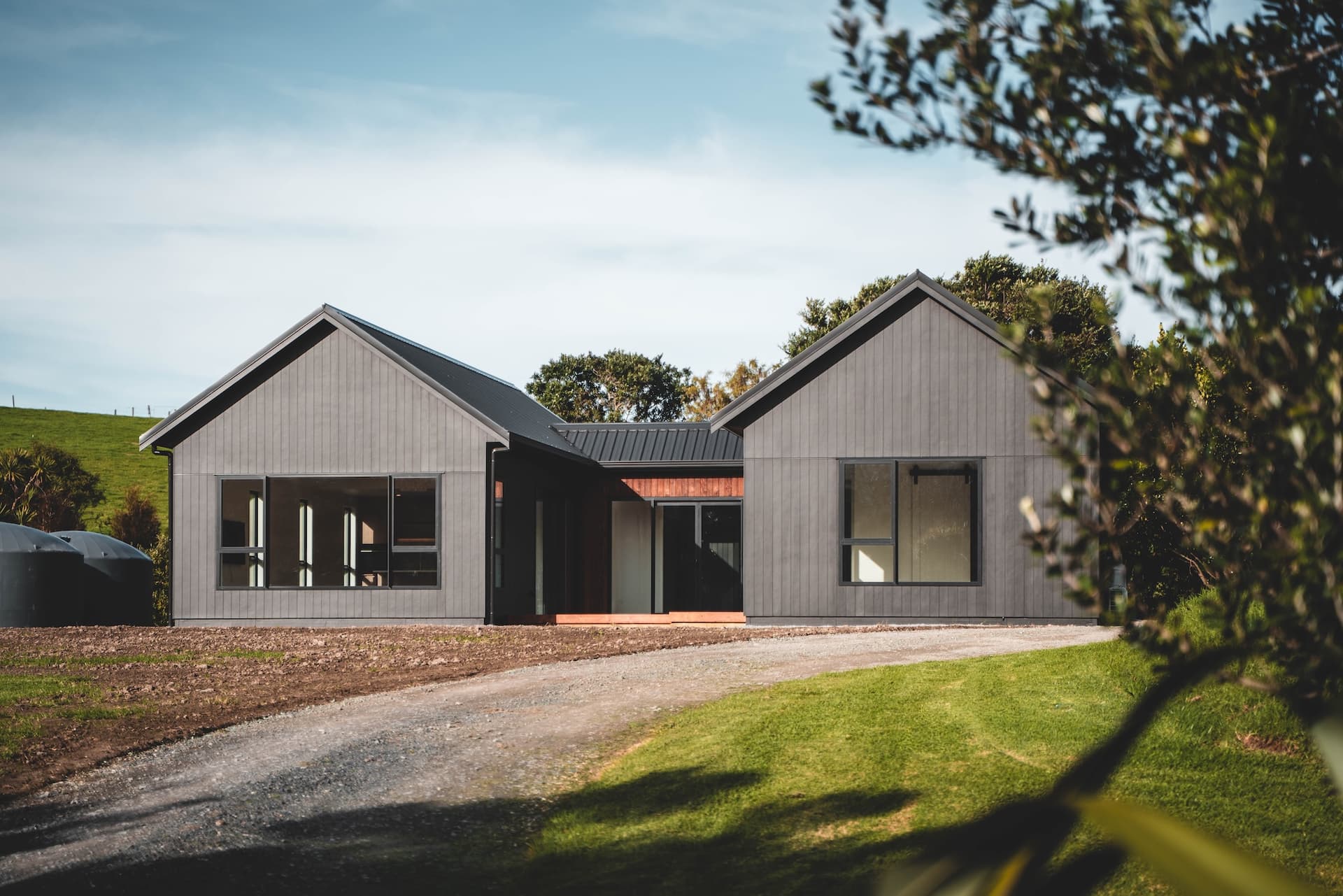
This is also the area where our own work sits - our recent Mangawhai builds include the Mangawhai Rural New Build (a multi-gable elevated rural home with exposed structural elements), the King Road Project (a completed timeless barn-style design-and-build on a rural Mangawhai block), and the Mangawhai Heads Outdoor Renovation (steel portal frame, reinforced slab, integrated pool). They're worth visiting on the projects page if you want to see the level of detail the premium end of the market actually involves.
7. Local proof - visit a site, talk to past clients
A builder's portfolio website tells you what they want you to see. A live site and a past client's kitchen tell you what they actually deliver.
For any Mangawhai builder on your shortlist:
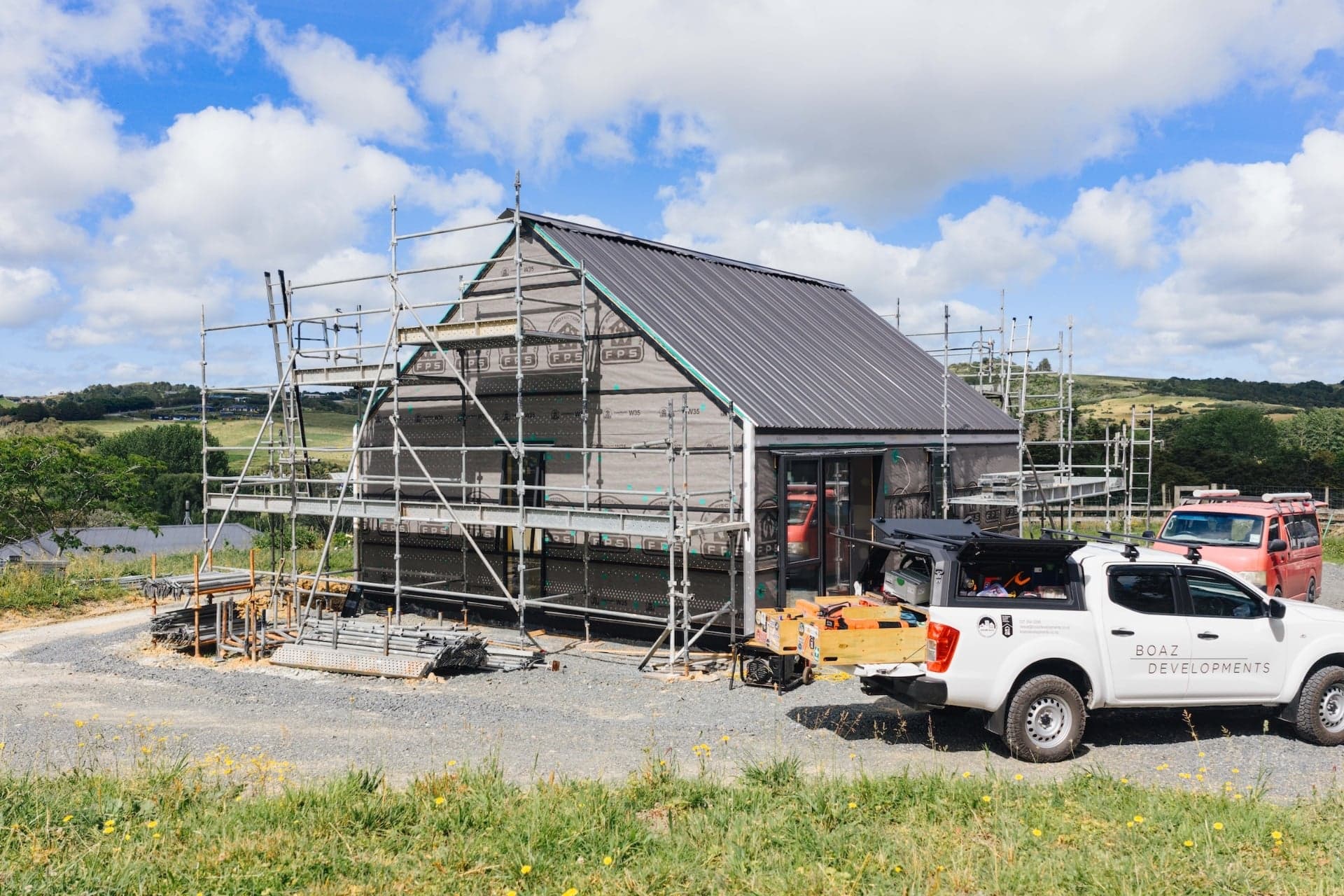
- Ask to visit a current site. A live site shows you the things a finished-photography portfolio doesn't - is the site clean, is rubbish managed, is timber stored and protected, are the sub-trades organised, is signage and fencing compliant. A builder who refuses a site visit is telling you something.
- Ask for a list of every Mangawhai project they've completed in the last three years, then pick two from the list yourself and contact those owners. The references handed to you on a printed sheet are pre-screened - you want the un-screened ones.
- Ask the past client four specific questions: Did the build come in on the budget you signed off on? Did variations get explained and priced before they happened? Was the site clean and safe throughout? Would you use this builder again, and why? The fourth question is the most useful - past clients will tell you things in conversation that they'd never have written in a testimonial.
We're based in Langs Beach, ten minutes south of Mangawhai. Most of our completed and current work is within a 25-minute radius of our base, which means it's all visit-able and the people who own it are reachable. That's not unusual - it's the pattern most of the genuinely local builders in this area work to. A builder claiming a "Mangawhai presence" who can't put you in the same room as a recent local client is one to be cautious of.
8. The 12 questions to ask any Mangawhai builder before you sign
This is the practical version. None of it is a substitute for the sections above, but printed off and asked in order, it surfaces a lot quickly.
- What's your LBP number, and which licence classes do you hold? (Verify on the public register before the next meeting.)
- How many Kaipara District Council consents have you personally taken from lodgement to CCC in the last 24 months?
- Who, by name, will be supervising the restricted building work on my project, and what's their LBP number?
- Are you offering a Master Build or Halo 10-Year Guarantee on this build, and if so what's the premium and what does it cover?
- What public liability and contract works insurance do you carry, and can I see the certificates?
- Will the contract be fixed-price or cost-plus, and on which standard contract form?
- How are PC sums and provisional sums set, and which line items in the quote are allowances rather than firm prices?
- What's your variation procedure - in writing or verbal?
- Can I see a current Mangawhai site this week, and contact two recent Mangawhai clients of my choice from your project list?
- What's the corrosion zone for my section under NZS 3604, and what fixings, cladding, and joinery are you specifying for it?
- Who are the three sub-trades on my build that you've worked with longest, and why those firms?
- If a problem appears in year three or year seven of the home's life, what's the actual process for me to call you, get it assessed, and get it remedied?
Question 12 is the one builders most often don't have a clean answer to. The strong ones do.
Frequently Asked Questions
Does my builder have to be a Licensed Building Practitioner in Mangawhai?
Yes - by law, restricted building work on a residential home in New Zealand must be carried out or supervised by a Licensed Building Practitioner. That includes anything that contributes to weathertightness or structural integrity - foundations, framing, roofing, cladding. You can verify any builder's LBP status free, in 30 seconds, on the public LBP register at lbp.govt.nz/public-register. If a Mangawhai builder hesitates when you ask for their LBP number, walk away.
Is a Master Build guarantee the same as Master Builders membership?
No - and this is one of the most common confusions. Master Builders (Registered Master Builders Association) is a trade association you pay to join. The Master Build 10-Year Guarantee is a separate insurance-backed product their members can offer to clients on a per-build basis. Membership alone does not guarantee your build. If you want the cover, ask the builder explicitly: "Will you be issuing a Master Build 10-Year Guarantee for my project, and what's the premium?" New Zealand Certified Builders offer an equivalent product called the Halo 10-Year Residential Guarantee.
What does Kaipara District Council expect that other councils don't?
Most of Mangawhai sits inside Kaipara District Council's jurisdiction (Te Arai is Auckland Council; Waipu and Langs Beach fall under Whangārei DC). KDC has its own coastal hazard overlays, on-site wastewater rules under TP58 and AS/NZS 1547, tank-water sizing minimums for rural homes, and specific rural-zone bulk-and-location standards. A builder who has never run a KDC consent before will often miss things that Auckland or Whangārei builders take as standard - and the corrections cost weeks. Always ask how many KDC consents the builder has personally taken from lodgement through to Code of Compliance Certificate.
What does "coastal-spec" or "marine-grade" actually mean for a Mangawhai build?
It means specifying materials that won't fail in the airborne salt environment that affects the entire Mangawhai-Heads-to-Langs-Beach coastline. Practically: stainless steel grade 316 fixings (not 304, not galvanised) anywhere exposed; cladding systems that meet E2/AS1 for the relevant exposure zone; thermally broken aluminium or timber-framed joinery rated for the wind load (most Mangawhai sites are High or Very High wind zone under NZS 3604); and durable secondary detailing - flashings, fasteners, fastener washers - that won't be the first thing to corrode. Inland-spec materials in this environment fail visibly within three to five years.
What's the difference between a fixed-price quote and a cost-plus contract?
A fixed-price contract sets the total build figure up-front based on a complete specification, and the builder carries the risk of cost movements within that scope. A cost-plus contract bills you for actual labour and materials plus a margin (typically 15-20%), and you carry the risk of overruns. Fixed-price is the right default for a new build with a complete plan set. Cost-plus has a place on older home renovations where significant unknowns sit behind existing wall linings - but only with a transparent, well-defined margin and clear allowances. If you're being offered cost-plus on a clean new-build site, ask why.
How do I tell a competent mid-spec builder from one who can deliver a premium architectural coastal home?
Ask to see their last three architecturally-designed builds, ideally ones where they were pricing from a full architect's documentation set rather than a builder-supplied plan. Look at how they handled the parts that separate good from average: cantilever and long-span structural detailing, minimal-frame glazing, cedar and composite cladding junctions, custom joinery, and the thresholds between indoor and outdoor living. The cheap test: ask them to describe an architectural detail on a recent build that gave them genuine difficulty, and how they solved it. A builder who has never wrestled with that level of detail will deflect. One who has will get specific quickly.
Should I get references from past Mangawhai clients?
Always - and don't accept the references handed to you on a printed sheet. Ask for a list of every Mangawhai project the builder has completed in the past three years, then pick two yourself and contact those owners. The questions worth asking the past client: did the build come in on the budget you signed off on, did variations get explained and priced before they happened, was the site clean and safe, and would you use this builder for your next project. The third question is the most useful - past clients will sometimes tell you things they wouldn't have written in a testimonial.
Why does it matter whether the crew lives in the area?
Two reasons. First, response time on site queries during a build - a local builder is on the road in 15 minutes; an Auckland-based one is committing to a two-hour round trip per visit and will visit less often as a result. Second, accountability. A builder who lives where their work stands has a different incentive structure to one who can drive away. We're based in Langs Beach and most of our completed work is within a 25-minute radius - it's a deliberate choice, not a marketing line.
Talk to us about your Mangawhai project
If you're working through a builder shortlist for a Mangawhai new build, renovation, or extension, we'd be happy to be on it - or to give you an honest read on a competing quote you've received. Either is a free conversation.
We work across Mangawhai, Mangawhai Heads, Te Arai, Langs Beach, Waipu and Ruakaka. For Mangawhai-specific renovation and extension work the relevant page is Renovations & Extensions Mangawhai; for coastal bach renovations at the Heads it's Bach Renovations Mangawhai Heads; for new-build work it's New Builds Northland. If you're still weighing up which side of the township to build on, see our Mangawhai Heads vs Mangawhai Village guide.
Get in touch for a free quote or a second-opinion conversation →
References in this guide: Building Act 2004 and Building (Designation of Building Work) Regulations via building.govt.nz; LBP public register at lbp.govt.nz; NZS 3604:2011 and AS/NZS 1547:2012 via standards.govt.nz; E2/AS1 External Moisture Acceptable Solution via building.govt.nz; BRANZ technical guidance via branz.co.nz; Master Build 10-Year Guarantee scheme via masterbuilder.co.nz; Halo 10-Year Residential Guarantee scheme via nzcb.nz; Kaipara District Council consent guidance via kaipara.govt.nz. This guide is general information from a working Northland builder, not legal or contractual advice. For project-specific advice, talk to a builder, a building lawyer, or your architect.
- Reece, Boaz Developments